

Emily's story
Physical Activity Lead, Emily joined Penny Brohn UK back in April 2024 and develops our educational and evidence-based physical activity programs for those affected by cancer.
She recently sat down with us to discuss her time at Penny Brohn UK and how important being able to acknowledge the importance of maintaining your own physical strength following a cancer diagnosis is.
What's your life like outside of Penny Brohn UK?
I always like to say that I’m a businesswoman first and foremost, but one of my most important jobs is as actually a Mum of 2. Throw in our collie, Mila, who’s absolutely nuts but gorgeous all the same, and we have a very busy household!
I am incredibly passionate about women’s health and work as a women’s and pelvic health coach providing workshops and advice. I love going on walks, getting out into nature. I do arts and crafts with my son on the weekends, we’re always getting up to crafty activities when we can. I really enjoy cooking, I love oriental cuisine and you will often find me dancing in the kitchen while I cook.

When and why did you decide to pursue a career in physical activity?
I started off working as a Cancer Nurse when I qualified. Then I went on to A&E and then Community Nursing in the NHS and I found that I was seeing a lot of elderly people who were really deconditioned due to various health conditions. This was really detrimental to their overall wellbeing – leaving them unable to physically look after themselves, and ultimately having a poor quality of life.
A lot of the time we found that physical rehab services would be part of the solution to helping them to build up their physical strength, and through the NHS we were unable to refer them to the appropriate service to help them do this due to limited capacity and long wait lists. I felt that our leisure providers were an untapped service that could support the community in being stronger and fitter, particularly after illness or as we age.
I wanted to learn more about physical activity, and so I trained as a Personal Trainer. During that time, I completed a course on helping older adults with their physical health. And then just as I qualified, the pandemic hit.
After that period, an opportunity came up working for the Bladder and Bowel service, which really opened up my knowledge on women’s health, including the importance of focussing on your pelvic health.
Around that time, I started working for GenesisCare as their Personal Trainer in the Exercise Medicine department, and worked there for 3 years. It was through this role that I learnt about Penny Brohn UK, who GenesisCare hold a partnership with, and started to learn more about the toolbox of support they provide to help people feel more informed and supported with their cancer in ways that work for them. The work with the Wellbeing Consultants showcased the personalised approach in how they care for those affected by cancer. This really fuelled my passion to work in that kind of way because I was able to meet and learn from other healthcare professionals (nutritionists, counsellors, doctors and nurses) who were dual-trained, which is something that I’d not come across before.
How did you come to be at Penny Brohn UK?
After I’d had my 2nd child, an opportunity came up as the Physical Lead at Penny Brohn UK and I jumped at the chance. I really admired the work that they do through my time at GenesisCare and wanted to be a part of that, to work in collaboration with other like-minded professionals. Becoming part of the medical model that also realises that the personalised aspect is also important to help people truly thrive, and not just survive.
By working together, we would be able to ensure that everyone with cancer could learn not only about the benefits of taking care of their physical health, but also that there is that balance that plays with also looking after their mind and nutrition amongst other things.
In a completely separate event, I was actually driving on the motorway whilst I was working at GenesisCare and I was listening to The Doctor’s Kitchen podcast, and the episode I was on featured Penny Brohn UK’s very own Catherine Zollman. That was the first time I think my personal and professional interest in the charity collided.
What does a typical day as a Physical Activity Lead look like?
I definitely spend at least a morning clearing out my inbox!
I work both from home and at the Centre in Pill. I organise all of the Physical Activity sessions that you see online (Gentle Movement Snack with India, Strength & Stamina with Emily, Gentle Yoga and Movement with Olivia and Tai Chi with Kimberley), as well as the movement element of our Wellbeing Days and Living Well Retreats.
I also co-ordinate some of the incredible volunteers who help us to facilitate these sessions, from Lorna who leads our new Nordic Walking group on a Tuesday, to the individuals who host our in-person and online sessions.
If I run through a typical session, whether online or in-person at our Wellbeing Days, we tend to start with a quick warm up. This is then followed by exercises designed to focus on joint mobility, with joint stiffness and aches being common concerns for people with cancer. We’ll then run through some strength and mobility exercises, focussing on full body strength. This helps to give them confidence and gets that heart rate up and blood pumping! We’ll tailor these exercises based on the different stages of treatment that the individuals participating may be at. We then finish with a cool-down exercise, giving them an opportunity to breathe and really move into a restorative state, and reflecting positively on what they have been able to achieve.
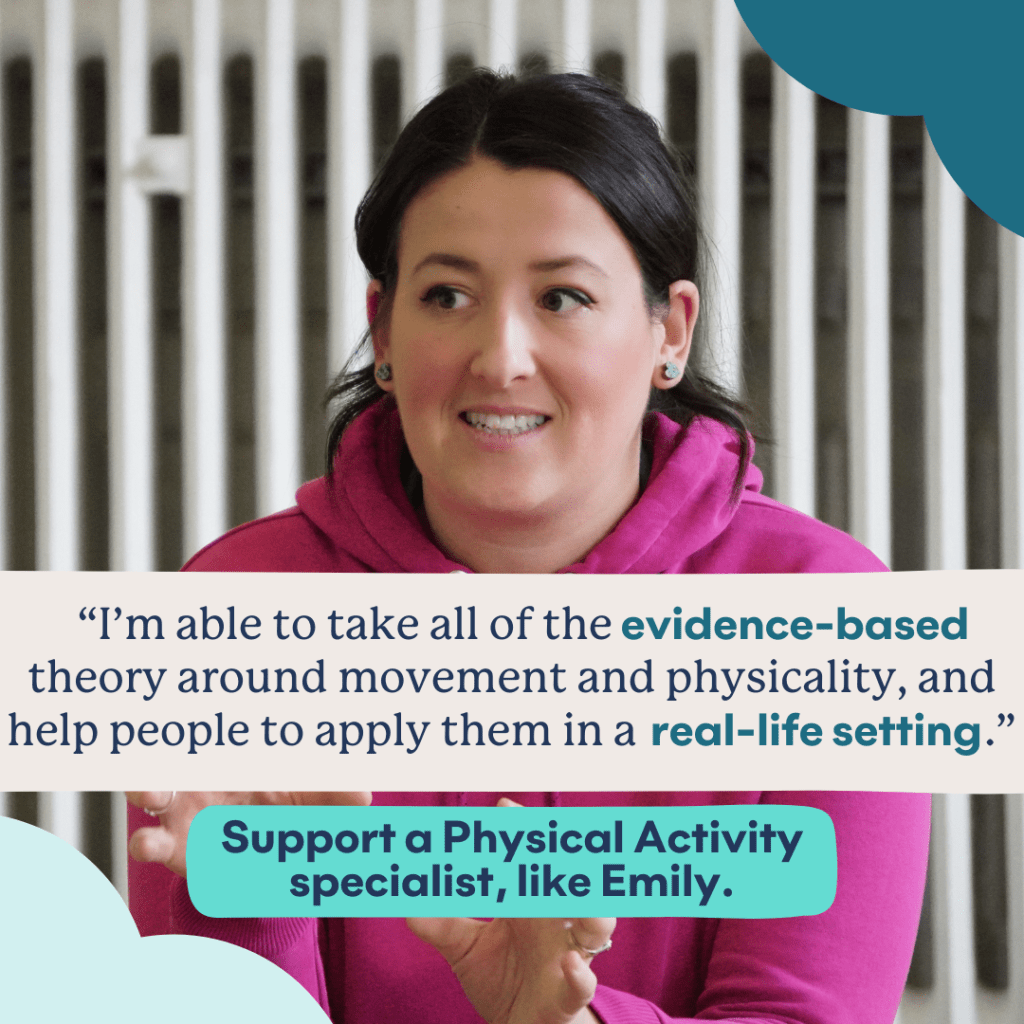
Through the Penny Brohn UK approach I’m able to take all of the evidence-based theory around movement and physicality, and help people to apply them in a real-life setting. Knowing that they’re exercising in a safe environment, with an instructor who can step in if needed reduces the fear that a lot of people can have around moving after a cancer diagnosis
Looking to the future, we’re really excited to be working on a project for Prehabilitation. Prehabilitation is a proactive approach that involves physical, nutritional, and psychological interventions to enhance a person’s strength, resilience, and overall health before cancer treatment, aiming to improve outcomes and reduce treatment-related complications We’ve been working alongside a local cancer alliance to design an online offering for our clients – including physical activity, nutrition, mental and emotional support, because we recognise there’s a growing gap between the time of diagnosis and treatment to receive support. Funding is scarce but we are passionate about supporting people during this pivotal time in someone’s cancer pathway.
What do you find the most rewarding about working at Penny Brohn UK?
It’s really hard to pinpoint exactly, but I would say what I find most rewarding is when I’m stood in front of a client and I see their shoulders physically drop. You can see the worry and burden fall from their body, they feel a sense of relief, especially when their fears and anxieties have been heard. Particularly around movement, so many people stop exercising due to fear or pain and I love it when they learn they can start moving or learn to adapt it.
I can also apply some of that multi-faceted expertise that I was talking about before. For example, if someone comes to me asking a question about their lymphoedema then I can provide them with the best advice and guidance across all of Penny Brohn UK’s service, and they can go away often feeling more positively and optimistic about the future. It gives people the hope that they can live a good quality of life, no matter their diagnosis.
What do you find to be the most challenging part of your job?
I think it’s really challenging wanting to help everyone, knowing that it’s just not possible. Whether due to the resource we have, or down to the funding challenges that all charities across the country are currently facing.
We always pride ourselves on wanting to do things to the highest possible quality, but we often have to reign ourselves in and hold ourselves back a bit to focus on what’s really important and how we can continue to design and develop our services to support this.
One thing that Penny Brohn UK do very well, despite all of the challenges, is that we provide a lot of high quality care. I just wish more people and NHS professionals knew about us. All of the staff here really do work their socks off to provide high-level, evidence-based services despite all of the challenges that we face and that’s a real testament to every single one of them. As someone who’s had a background in working for the NHS I’m blown away by some of the services we provide.

We’d like to thank Emily for sharing their experience. The words used are preferred by Emily. Penny Brohn UK encourages everyone to use their own words to tell their story. If you have any questions about any of the language used, please email comms@pennybrohn.org.uk.